

The Congo Basin is the world largest rainforests, second only to the Amazon. In 2019 75% of the Republic of Congo was tree cover. It lost 73,800 hectares of forest in 2019, equivalent to 26.8Mt of CO₂ of emissions. Congo’s rainforest is one of the most intact in the world, but it is being cut down. The hardwood timber from tropical trees is sold on the international market and bought by consumers in Europe, America and Asia in the form of furniture, plywood and even charcoal. If Congo were not so isolated, the rate of forest loss might be much higher. Congo’s lack of infrastructure makes it hard for loggers to export the timber and discourages large concessions from clear cutting the forest for agriculture.
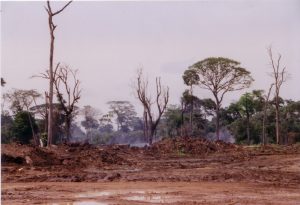
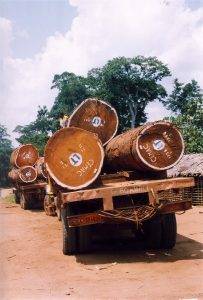 I visited a logging company in northern Congo and saw the destructive reality of the timber industry in action. Huge sapelli trees were being cut down and dragged out of the forest, caterpillar tracks churning up the soil, the trunks crushing smaller trees as they were pulled out. The logging roads are cut through the forest, like glaring gashes in the green. The heavy machinery destroys the seed bank that lies within the soil so the trees are less likely to reproduce. Primary forest is cool and open under the canopy but after logging climbers and grasses quickly grow up. The air temperature can rise by four degrees Celsius after selective felling, and soil temperature can rise from 25 to 40 degrees, radically altering the environment for indigenous species.
Where there are roads, there are people. Given the poverty in Congo, people seek a better life, and move into the forest to start farming or to sell their own timber or charcoal on the informal market. The roads give better access to the forest for hunting, and the towns in northern Congo sell bush meat: porcupine, antelope, monkey, bat, crocodile and wild boar – even chimpanzee and gorilla.
Logging companies are notorious for doctoring their books to avoid paying tax, selling the timber to their parent company in Europe for a fraction of its real value so that their in-country records showed marginal profits or even a loss. In theory the government controls which trees are cut down: a map is submitted with each tree to be felled marked and given a unique identifying number. The government approves this map and the number of trees cannot be exceeded. But a French employee at a logging company in Betou told me that they chopped down trees that had not been approved by the government in the annual plan, assigning them fake identity codes which they painted onto the trunks in white paint.
Most Congolese are supportive of the extraction of timber from Congo’s forests, but critical of their government for the corruption which means that none of the money goes into public services. One local forestry official in Ouesso explained:
“After all, it’ss the people in Europe who are buying this wood. There is the market for it and we are providing it. There’s nothing illegal in that. What is illegal is the way the Congolese government is pocketing the money. Congo is rich in natural resources but we, the people, never see those riches. The thing that needs to be changed is the way the Congolese government makes all this money disappear as if it never existed.”