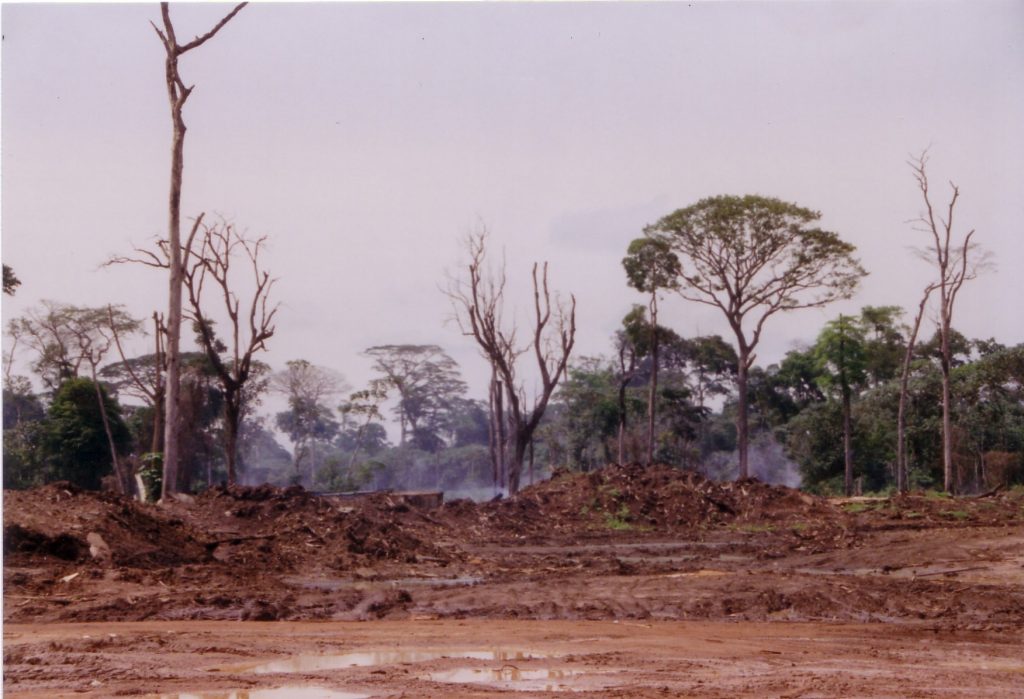
Today, on World Earth Day 2021, we need to protect our forests. Forests provide a solution to the double crisis we face: the ecological crisis and climate crisis. Tropical forests are home to incredible biodiversity and they sequester carbon. Not only this – they are also home to indigenous peoples and local communities; they are fundamental to the water cycle; and their destruction triggers the spread of zoonotic diseases and increases the risk of future pandemics.
Nearly two thirds of the land mass in Congo is covered in forest. Congo has a staggering 23 million hectares of beautiful tropical rainforest. Congo even has part of the world’s largest peatland, the Cuvette Centrale peatland complex, which stores 30.6 Pg of carbon – as much carbon as is stored in all the trees of the entire Congo Basin ( Dargie et al. 2017 ).
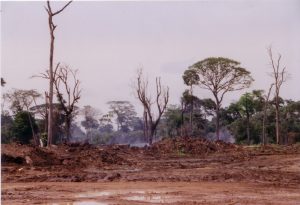
But it has lost more than 3% of its forest since 2000. Just last year, in 2020, Congo lost over 64,000 hectares of forest – equivalent to more than ten Manhattans.
Three quarters of Congo’s forests has been assigned to logging, mining or plantation concessions.
The Global Forest Watch database lists sixty-two logging concessions covering over thirteen million hectares, and an additional 465,349 hectares in fourteen oil palm concessions. The logging sector lobbies hard to maintain the fiction that it is sustainable. In a letter protesting the ban on the use of hardwoods in the Olympic Village, representatives of France’s timber compaies claim that sustainable tropical timber has a positive social and economic impact. They claim that banning sustainable, FSC-certified timber will damage the economies of Congo (and other producer countries) and of France, where so much is processed. But the FSC (Forest Stewardship Council) certification which is meant to be a guarantor of “responsible forest management” is not what it seems.
The largest logging concession in the Republic of Congo, Industrie Forestière d’Ouesso (IFO), covers over 1.2 million hectares. But nearly 50,000 hectares were lost between 2013 and 2019 (GFW 2020). This means that an area of forest bigger than Andorra, with all the thousands of plants, insects, birds, mammals living it, was transformed from dense green canopy to zero tree cover. And yet IFO is FSC certified, meaning that its timber is traded as sustainable timber.
And that is not all. In its 2018 FSC audit, local villagers said they feared the IFO eco-guards for raiding and burning villages that were suspected of poaching. The auditors found evidence that the guards had invaded houses to seize meat and basic hunting weapons, and sometimes imposed unapproved fines (Rainforest Alliance 2018).
It is time to recognise that consumer demand for tropical wood products in the UK, Europe, America and China is destroying the world’s last remaining tropical forest. The cosy relationship between heads of state and timber companies needs to be addressed and reset. It is not possible to continue logging at the current rate and pretend that it is sustainable.
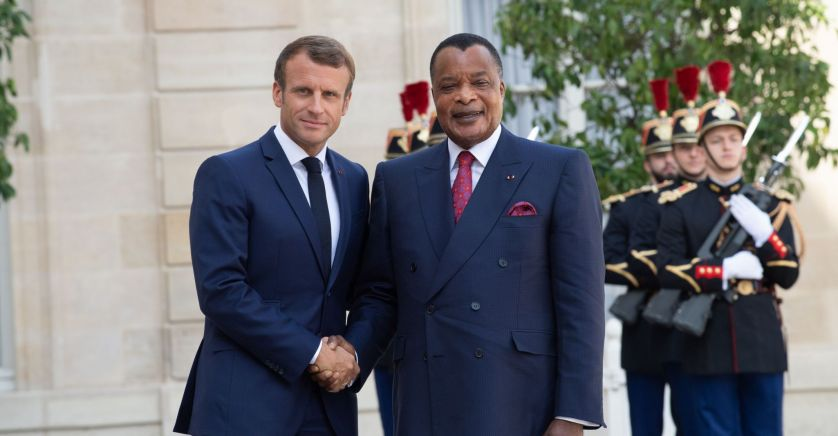
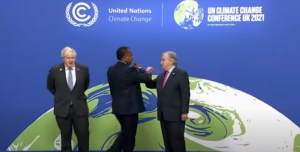
President Sassou Nguesso is head of the Climate Commission for the Congo Basin which is seeking financing from development banks for its projects to stop deforestation and forest degradation. But there is a slim chance that the money will be well spent. Congo is ranked 165th out of 179 countries
in Transparency International’s 2020 Corruption Perceptions Index. Are huge loans needed to stop the wilful destruction of the forests for the profit of European logging companies? Congo’s forests are being sold to line the pockets of its politicians – it is best that development banks avoid the same fate for their funds.